
Case study:
Building a Design Quality Team at Toyota.
Establishing the processes, governance, and shared foundations needed to support a rapidly scaling organisation.

Overview.
As the vehicle ecosystem expanded, the number of product teams contributing to the platform grew rapidly.
While this increased delivery speed, it also introduced challenges around consistency, accessibility, and design quality. Teams were solving similar problems independently, leading to duplicated patterns and fragmented experiences.
To address this, we established a cross-disciplinary quality team responsible for defining standards, governance, and processes that could support design quality across the organisation.
Company: Toyota Connected Europe / Toyota Motor Europe
Role: Lead Product Designer
Timeline: Mar 2024 - Present

The Challenge.
The vehicle ecosystem was growing quickly. Multiple squads were working on different parts of the platform across brands and markets.
As the organisation scaled, team autonomy increased - but alignment did not.
This led to several problems:
-
inconsistent product experiences across teams,
-
design system adoption varied widely,
-
accessibility practices were inconsistent,
-
UX copy lacked a unified voice,
-
decisions were being repeated across teams.
What initially looked like a design system problem was actually a broader organisational challenge.
Teams needed clearer standards, stronger governance, and shared processes to maintain quality while continuing to move quickly.
My Role.
As Lead Product Designer for Experience Standards, I was responsible for defining how design quality would scale across the organisation.
My responsibilities included:
-
defining the operating model for the design quality team,
-
aligning stakeholders across product, engineering, and design,
-
establishing governance and contribution frameworks,
-
introducing accessibility and UX writing standards,
-
supporting teams adopting the design system.
This role focused on enabling teams to deliver consistent product experiences at scale.

Discovery.
To understand the root causes of the issues, I spoke with designers, engineers, product managers and leadership across the organisation.
Several patterns quickly emerged.
Key challenges:
-
no shared design principles guiding decisions,
-
weak governance around system changes,
-
lack of ownership for standards and quality,
-
teams working in silos,
-
no consistent process for design review or decision-making,
-
without a shared framework, teams were solving the same problems repeatedly.
It became clear that solving this problem required organisational design, not just UI guidelines.
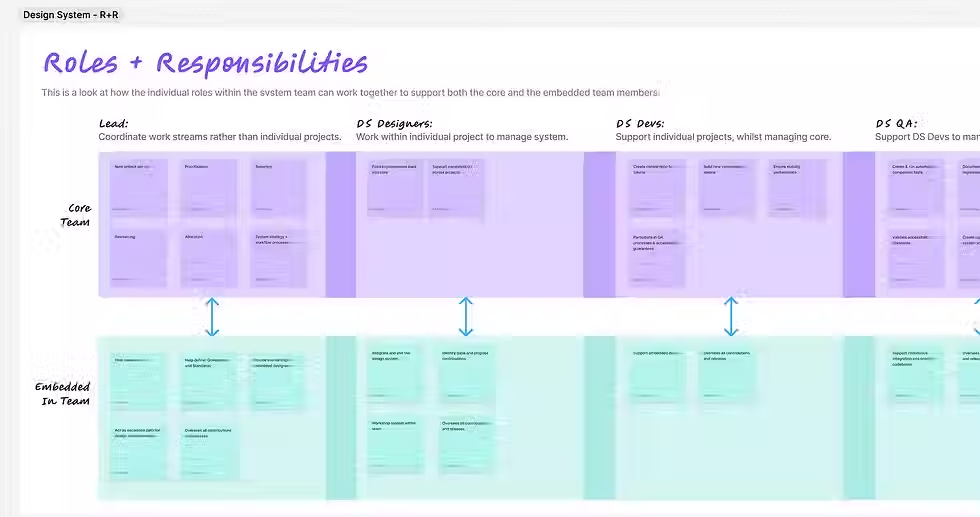
Designing the Team.
The first step was defining the structure needed to support quality across the organisation.
This helped the team identify opportunities to improve both product usability and brand expression across the connected vehicle apps.
To do this, I created a dedicated team focused on experience standards.
Team composition:
-
1x Design Lead (Myself 🤓),
-
2x Senior Design System Designers,
-
1x Content Lead,
-
1x Accessibility Lead,
-
2x Senior Developers,
-
1x QA Engineer.
This team served as a central support group for product squads, ensuring standards were maintained without slowing teams.

Governance Model.
To support the system over the long term, I introduced a governance model that balanced central guidance with team autonomy.
The governance model focused on several key pillars:
Centralised foundations.
Core system elements such as components, tokens and accessibility rules were maintained by the central team.
Shared ownership.
Product teams could contribute improvements and extensions to the system.
Modular design.
The system was structured to allow teams to adapt components while maintaining consistency.
Continuous collaboration.
Regular feedback loops ensured the system evolved alongside the product.
This model helped create a sustainable structure for scaling quality across multiple teams and brands.

Establishing Standards.
With the team and governance model in place, we introduced several new frameworks to support product teams.
Design Review Process.
We created a shared sign-off process that allowed teams to review and validate design decisions before implementation.
This ensured that:
-
accessibility standards were met,
-
system components were used correctly,
-
design patterns remained consistent.

Contribution & Deprecation Models.
To keep the design system evolving sustainably, we introduced a formal contribution process.
Teams could propose new components or improvements while the central team reviewed and maintained the system.
We also defined deprecation workflows to remove outdated components and patterns safely.

Accessibility Checklist.
To improve accessibility implementation, we introduced a development checklist used by designers, engineers and QA teams.
The checklist helped ensure:
-
correct token usage,
-
consistent spacing and layout rules,
-
accessible component configuration,
-
correct implementation of system components.
This simplified accessibility compliance and reduced review cycles.

UX Writing Standards.
We also introduced tone-of-voice guidelines for UX content.
These guidelines created a shared reference for:
-
error messages,
-
prompts,
-
system feedback,
-
onboarding content.
This helped create a more consistent experience across the platform.

Impact.
The new quality team and governance model helped improve alignment and product consistency across the organisation.
Key outcomes included:
1. Defined new operating models for scaling design quality across teams.
2. Alignment across senior stakeholders, creating shared ownership of standards.
3. A cross-functional centre of excellence supporting design systems, accessibility, and UX writing.
4. Clearer processes for teams, reducing repeated decision-making and improving collaboration.
The operating model continues to support the growth of Toyota’s vehicle platform.
Reflection.
This project reinforced several important lessons about scaling product design.
1. Standardisation is cultural, not just technical
Creating standards requires alignment across people, processes, and tools.
2. Guardrails enable creativity
Clear frameworks allow teams to move faster without sacrificing quality.
3. Scaling design requires shared language
When teams have a common system and vocabulary, collaboration becomes significantly easier.
Ultimately, this project helped establish the organisational foundations needed to support Toyota’s growing vehicle ecosystem.